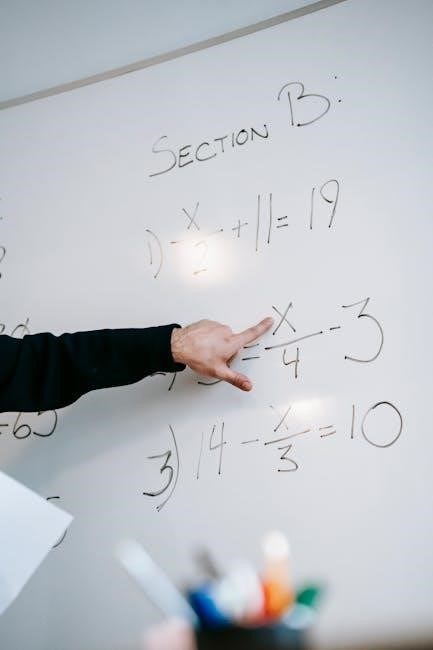
grade 9 math textbook pdf
Grade 9 Math Textbook PDF: A Comprehensive Guide
Grade 9 math textbooks in PDF format offer accessible learning resources, including options like “Math Makes Sense” and “Principles of Mathematics 9”, readily available online.
These digital versions provide convenient study materials for students, often sourced from publishers or educational platforms, ensuring comprehensive mathematical understanding.
Understanding the Demand for PDF Textbooks
The increasing demand for Grade 9 math textbook PDFs stems from a confluence of factors centered around accessibility and convenience. Students benefit from having learning materials available on various devices – laptops, tablets, and smartphones – facilitating study anytime, anywhere.
PDFs eliminate the need to carry heavy physical textbooks, a significant advantage for students with busy schedules. Furthermore, the digital format enables features like searching, highlighting, and annotation, enhancing the learning experience. Cost-effectiveness also plays a role, as PDFs can sometimes be obtained at a lower price point than traditional textbooks.
The availability of resources like “Math Makes Sense” and “Principles of Mathematics 9” in PDF format caters to diverse learning preferences and promotes independent study, ultimately supporting academic success.
Popular Grade 9 Math Textbook Options
Several Grade 9 math textbooks are widely used and frequently sought in PDF format. McGraw-Hill Ryerson’s “Principles of Mathematics 9” is a prominent choice, known for its comprehensive coverage of core mathematical concepts and rigorous approach.
Another popular option is “Math Makes Sense for Grade 9”, which emphasizes real-world applications and a more student-friendly presentation. Both textbooks are designed to align with provincial curricula and prepare students for higher-level math courses.
The availability of these titles as PDFs allows students greater flexibility in accessing and utilizing these valuable resources, supporting diverse learning styles and promoting academic achievement. These options cater to varied pedagogical approaches.

McGraw-Hill Ryerson “Principles of Mathematics 9”
“Principles of Mathematics 9” by McGraw-Hill Ryerson is a widely adopted textbook, offering a robust curriculum and detailed explanations for Grade 9 students.
Authors and Contributors to “Principles of Mathematics 9”
“Principles of Mathematics 9” benefits from the expertise of several dedicated authors and contributors, ensuring a comprehensive and well-structured learning experience for students. Key authors include Fred Ferneyhough (B.Math., B.Ed., Peel District School Board), Roland W. Meisel (B.Sc., B.Ed., M.Sc., District School Board of Niagara), and others with extensive backgrounds in mathematics education.
Chris Dearling and Brian McCudden served as Assessment Consultants, while Roland W. Meisel also contributed as a Technology Consultant. Derrick Driscoll provided valuable insights as a Literacy Consultant. These individuals, representing various school boards and Queen’s University, collaborated to create a textbook aligned with curriculum standards and designed to foster student success in Grade 9 mathematics.
Copyright and Usage Restrictions
“Principles of Mathematics 9”, published by McGraw-Hill Ryerson Limited in 2006, is protected by copyright law. Reproduction or transmission of any part of this textbook, in any form, requires prior written permission from McGraw-Hill Ryerson. This includes storage in a database or retrieval system.
For photocopying or reprographic copying, a license from the Canadian Copyright Licensing Agency (Access Copyright) is necessary. Access Copyright can be contacted via their website, www.accesscopyright.ca. Unauthorized distribution or modification of the PDF version constitutes a violation of copyright regulations and intellectual property rights. Respecting these restrictions ensures the continued availability of quality educational resources.
Geographical Distribution of the Textbook
“Principles of Mathematics 9”, as indicated in the McGraw-Hill Ryerson PDF, demonstrates a broad geographical distribution. The textbook is listed as being available in Toronto, Montréal, Boston, Burr Ridge (IL), Dubuque (IA), Madison (WI), New York, San Francisco, St. Louis, Bangkok, Bogotá, Kuala Lumpur, Lisbon, London, Madrid, Mexico City, Milan, New Delhi, Santiago, Seoul, Singapore, Sydney, and Taipei.
This extensive listing suggests a deliberate effort to cater to diverse educational systems and student populations internationally. The textbook’s reach extends across North and South America, Europe, Asia, and Australia, highlighting its global relevance and adoption within various curricula.

“Math Makes Sense for Grade 9” Textbook
“Math Makes Sense for Grade 9” is available as a PDF, offering real-world applications of mathematics and serving as a valuable learning resource;
Real-World Applications in “Math Makes Sense”
“Math Makes Sense for Grade 9” distinguishes itself by intentionally weaving mathematical concepts into relatable, everyday scenarios. The textbook doesn’t present equations and formulas in isolation; instead, it demonstrates their practical relevance through brand names and situations students encounter regularly.
This approach aims to enhance comprehension and engagement by illustrating how mathematics isn’t merely an abstract academic discipline, but a powerful tool for understanding and navigating the world. The textbook’s use of familiar brand names within problem-solving contexts provides a “sense of the real-world applications” of the mathematical principles being taught.
By grounding abstract ideas in concrete examples, “Math Makes Sense” strives to make learning more meaningful and accessible for Grade 9 students, fostering a deeper appreciation for the utility of mathematics.
Availability of the PDF Version
PDF versions of “Math Makes Sense for Grade 9” are discoverable online through various sources, including websites like LAYP (layp.yolasite.com). These platforms offer digital access to the textbook, potentially providing a convenient alternative to physical copies for students and educators.
However, it’s crucial to exercise caution when downloading PDFs from unofficial sources due to potential copyright infringements and security risks. While readily available, the legality and safety of these downloads should be carefully considered.
Accessing the PDF directly from official publisher websites or authorized educational resource platforms is generally the most secure and legally sound approach, ensuring a legitimate and reliable learning resource.

Key Mathematical Topics Covered in Grade 9
Grade 9 math encompasses algebraic foundations, linear equations, geometry, measurement, and data analysis, providing a crucial base for future mathematical studies.
Algebraic Foundations
Algebraic foundations in Grade 9 establish the core principles for manipulating mathematical expressions and solving equations. Textbooks like “Principles of Mathematics 9” and “Math Makes Sense” introduce students to variables, constants, and coefficients, building blocks for more complex concepts.

Students learn to simplify expressions by combining like terms and applying the distributive property. Emphasis is placed on understanding the order of operations (PEMDAS/BODMAS) to ensure accurate calculations. Furthermore, the curriculum covers evaluating algebraic expressions by substituting values for variables.
These foundational skills are essential for tackling linear equations and inequalities later in the year, and are presented within the context of real-world applications, as highlighted in resources available in PDF format.
Linear Equations and Inequalities
Grade 9 math textbooks, often available as PDFs, dedicate significant attention to linear equations and inequalities. Students learn to solve one-step, two-step, and multi-step equations using inverse operations, a skill reinforced in resources like “Principles of Mathematics 9”.
The concept of equality is extended to inequalities, with students understanding the rules for manipulating these expressions and representing solutions on number lines. Textbooks like “Math Makes Sense” often present real-world scenarios requiring the formulation and solution of linear equations.
Graphing linear equations is introduced, laying the groundwork for more advanced algebraic concepts. PDF versions allow for interactive practice and review of these crucial skills.
Geometry and Measurement
Grade 9 math textbooks in PDF format comprehensively cover geometry and measurement, building foundational skills. Students explore angle relationships, geometric constructions, and properties of 2D shapes like triangles and quadrilaterals, often detailed in resources like “Principles of Mathematics 9”.
Area, perimeter, and volume calculations for various geometric figures are emphasized, with practical applications presented. “Math Makes Sense” frequently incorporates real-world examples to illustrate these concepts.
Units of measurement, conversions, and the Pythagorean theorem are also key components. PDF textbooks facilitate visual learning through diagrams and allow students to practice calculations efficiently, solidifying their understanding of spatial reasoning.
Data Analysis and Probability
Grade 9 math textbooks in PDF format dedicate significant sections to data analysis and probability, equipping students with essential statistical skills. These resources, such as “Principles of Mathematics 9” and “Math Makes Sense”, introduce concepts like collecting, organizing, and interpreting data using various graphical representations.
Measures of central tendency – mean, median, and mode – are thoroughly explained, alongside range and standard deviation. Probability is explored through experiments, theoretical calculations, and the use of tree diagrams and sample spaces.
PDF versions allow for interactive exercises and reinforce understanding through real-world applications, preparing students for more advanced statistical studies.

Where to Find Grade 9 Math Textbook PDFs Online
Grade 9 math textbook PDFs are accessible through official publisher websites like McGraw-Hill Ryerson, and educational resource platforms, offering convenient learning options.
Official Publisher Websites
Accessing Grade 9 math textbook PDFs directly from official publisher websites, such as McGraw-Hill Ryerson, is a reliable and legal method. These platforms often provide sample chapters or even full textbook access, sometimes requiring registration or purchase.
McGraw-Hill Ryerson, for instance, distributes “Principles of Mathematics 9” and related resources through its official channels. Checking these sites ensures you’re obtaining a legitimate copy, free from potential malware or copyright infringements associated with unofficial sources.
Furthermore, publishers frequently offer supplementary materials like answer keys, teacher resources, and interactive tools alongside the PDF versions, enhancing the learning experience. Always prioritize official sources for quality and security when seeking digital textbooks.
Educational Resource Platforms
Numerous educational resource platforms host Grade 9 math textbook PDFs, offering students convenient access to learning materials. These platforms often curate content from various publishers, providing a centralized location for finding resources like “Math Makes Sense” or “Principles of Mathematics 9”.
However, it’s crucial to verify the legitimacy of the source and ensure compliance with copyright regulations. Some platforms require subscriptions or fees for access, while others offer free resources with potential limitations.
Carefully evaluate the platform’s reputation and user reviews before downloading any PDF to safeguard against malware or inaccurate content. These platforms can be valuable tools, but responsible usage and source verification are paramount.
Potential Risks of Downloading PDFs from Unofficial Sources
Downloading Grade 9 math textbook PDFs from unofficial sources carries significant risks. These files may contain malware, viruses, or other malicious software that can compromise your device and personal information. The quality of the PDF can also be questionable, potentially featuring missing pages, formatting errors, or inaccurate content.
Furthermore, obtaining textbooks from unauthorized websites constitutes copyright infringement, which is illegal and unethical. Such sources often lack proper licensing and permissions from publishers like McGraw-Hill Ryerson.

Prioritize official publisher websites or reputable educational platforms to ensure a safe and legal download experience, protecting both your digital security and intellectual property rights.

Legality and Ethical Considerations
Downloading Grade 9 math textbook PDFs requires respecting copyright laws and intellectual property. Unauthorized distribution violates publisher rights, like McGraw-Hill Ryerson’s.
Copyright Laws and Textbook PDFs
Copyright laws significantly govern the distribution and use of Grade 9 math textbook PDFs. As stated by McGraw-Hill Ryerson, reproducing or transmitting any part of their publications requires prior written permission.
This includes photocopying, digital storage, or inclusion in retrieval systems. Access Copyright, a Canadian licensing agency, offers licenses for reprographic copying, providing a legal avenue for educators.
Downloading PDFs from unofficial sources often constitutes copyright infringement, potentially leading to legal consequences. Respecting these laws ensures fair compensation for authors and publishers, fostering continued creation of valuable educational resources. Utilizing legally obtained PDFs supports the educational ecosystem and upholds ethical standards.
Always verify the source and licensing terms before accessing or sharing any textbook PDF.
Respecting Intellectual Property
Respecting intellectual property is paramount when utilizing Grade 9 math textbook PDFs. Authors, contributors like Fred Ferneyhough and Roland W. Meisel, and publishers invest significant effort in creating these resources.

Unauthorized distribution or modification of these PDFs undermines their work and violates copyright regulations. Supporting legitimate channels for accessing textbooks – official publisher websites and licensed platforms – demonstrates ethical conduct.
Recognizing the value of educational materials encourages continued investment in quality content. Downloading from unofficial sources not only risks legal repercussions but also devalues the contributions of those involved in textbook development.
Prioritizing legal access ensures a sustainable ecosystem for educational resources and honors the creators’ rights.

Optimizing PDF Usage for Learning
Grade 9 math textbook PDFs benefit from annotation tools and offline access, enhancing study efficiency and device compatibility for focused learning.
PDF Annotation Tools
Utilizing PDF annotation tools significantly enhances the learning experience with Grade 9 math textbooks. These tools allow students to directly interact with the material, highlighting key concepts, defining unfamiliar terms, and adding personalized notes within the PDF document itself.
Features like text highlighting, sticky notes, and drawing tools facilitate active reading and deeper comprehension of complex mathematical principles. Students can also solve practice problems directly on the PDF, showcasing their work and identifying areas needing further review.
Furthermore, many PDF readers offer features like form filling, enabling students to complete worksheets and assignments digitally. This interactive approach transforms a static textbook into a dynamic learning resource, promoting engagement and improved academic performance.
Offline Access and Device Compatibility
Grade 9 math textbook PDFs offer a significant advantage through offline access, allowing students to study anytime, anywhere, without requiring an internet connection. This is particularly beneficial for commutes or areas with limited connectivity.
Furthermore, these PDFs demonstrate broad device compatibility, functioning seamlessly on smartphones, tablets, laptops, and desktop computers. Most modern devices support common PDF readers like Adobe Acrobat Reader, ensuring accessibility across various platforms.
This versatility enables students to learn using their preferred device, fostering a more comfortable and productive study environment. Consistent formatting across devices guarantees a uniform learning experience, regardless of the chosen platform.